

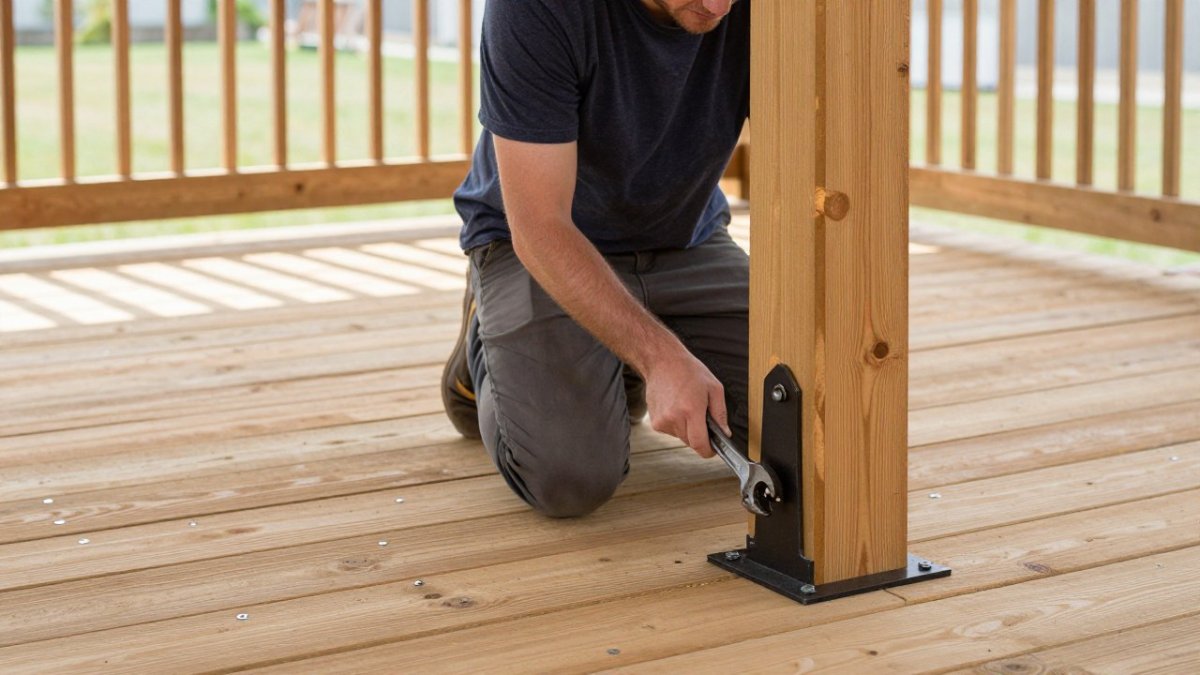
Last Updated: November 22, 2026
Quick Summary
Durable hardware for outdoor structures is fasteners, connectors, anchors, and brackets engineered to resist corrosion and hold structural loads for the life of the build. Match the metal to your exposure: hot-dip galvanized or ZMAX inland, 316 stainless near salt air, and coated or stainless connectors rated for ACQ/CA treated lumber.
- Inspect hardware twice a year, in spring and fall, and after any major storm.
- Stainless steel resists salt and chemical attack best, with 316-grade the coastal standard.
- Match the screw to the connector, or step both up to stainless, to avoid galvanic corrosion.
- Field-modifying a connector by bending, cutting, or enlarging holes voids its rating.
- Use rated structural screws or anchors, not deck screws, where a connection carries load.
Table of Contents
- Why Durable Hardware Decides How Long Your Structure Lasts
- How to Choose Hardware by Environmental Exposure
- Stainless Steel vs. Galvanized vs. Powder-Coated Hardware
- Stainless Steel Screws for Outdoor Use: What Actually Matters
- Fasteners for Pressure-Treated Lumber: Avoiding Hidden Corrosion
- Pergola Brackets and Connectors That Carry the Load
- Outdoor Wood Maintenance and Hardware Inspection Schedule
- Plan Your Hardware List With a Pergola World Consultation
- Frequently Asked Questions
Why Durable Hardware Decides How Long Your Structure Lasts
Durable hardware for outdoor structures is the category of fasteners, connectors, anchors, and brackets engineered to resist corrosion and hold structural loads for the life of the build.
A cedar pergola can outlive its builder, but the same pergola with the wrong joist hangers can start staining and loosening within a few seasons.
Below, we break down how to match durable hardware to your environment, lumber, and loads so the structure you build this fall is still square a decade from now.
How to Choose Hardware by Environmental Exposure
Start with exposure, not price. The environment around your structure determines which metal survives and which one fails quietly inside the wood.
Three variables drive the decision: moisture, salt, and chemical contact. Inland builds with good drainage tolerate hot-dip galvanized steel; coastal builds need stainless steel or a salt-rated coating; treated lumber needs hardware whose coating survives the chemicals in the wood.
Simpson Strong-Tie’s Outdoor Accents product documentation describes its decorative outdoor line as ZMAX galvanized steel with a black powder-coat finish, a combination built for exterior connectors that also need to look finished.
A Material-Selection Matrix for Inland, Coastal, and Treated-Lumber Builds
| Exposure | Recommended Metal | Avoid | Why |
|---|---|---|---|
| Inland, sheltered, good drainage | Hot-dip galvanized or ZMAX galvanized steel | Electro-galvanized | Zinc coating thickness drives service life |
| Inland, fully exposed | Powder-coated galvanized steel | Bright zinc-plated | Coating adds a barrier layer against repeated wetting |
| Coastal, salt air | Stainless steel, 316 grade preferred | Standard galvanized | Salt attacks zinc quickly |
| Treated lumber contact | Coated or stainless connectors rated for ACQ/CA | Bare aluminum, uncoated mild steel | Chemicals accelerate dissimilar-metal corrosion |
| Ground contact or post base | Mechanically galvanized anchors, elevated base | Wood buried directly | Standing water is the fastest path to failure |
For exposed builds where anchoring matters most, a mechanically galvanized heavy-duty screw anchor gives you a fastener rated for structural connection without relying on a coating that wears at the head. You can view the galvanized screw anchor we stock for these applications.
Stainless Steel vs. Galvanized vs. Powder-Coated Hardware
Stainless steel wins on corrosion resistance and loses on cost. Galvanized steel wins on value and needs thickness to perform. Powder coating wins on appearance and finish protection, but only when the base metal underneath is already corrosion-resistant.
- Stainless steel resists salt and chemical attack best, and 316-grade is the standard near the coast. It costs more and can gall if driven too fast.
- Galvanized steel relies on a zinc layer that sacrifices itself to protect the steel. Hot-dip and ZMAX last far longer than electro-galvanized, so coating type matters more than the word “galvanized.”
- Powder-coated steel adds a decorative barrier over a galvanized core, but a deep scratch exposes the metal underneath, so touch-up matters.
These are not competing categories so much as layers: the strongest exterior assemblies pair a corrosion-resistant core with a coating that protects the look. If you are weighing finishes for a visible build, you can see the black powder-coated hex-head washer that matches our coated connector line.
Stainless Steel Screws for Outdoor Use: What Actually Matters
Grade and coating matter more than head style. For most exterior wood connections, 304 stainless handles inland conditions and 316 stainless handles salt air. Anything less is a gamble you take once and live with for years.
Three details separate a screw that lasts from one that snaps:
- Grade match to exposure. Coastal and treated-lumber work calls for 316. Inland sheltered work can use 304.
- Coarse threads for wood. Construction screws with coarse threads bite into lumber and resist pull-out better than fine-thread alternatives.
- Countersunk heads for flush seating. A Torx-style countersunk head seats cleanly and reduces cam-out, which protects the coating around the hole.
A common mistake is mixing stainless screws with galvanized connectors. The two metals sit at different points on the galvanic scale, and moisture between them accelerates corrosion on the less noble metal.
Fasteners for Pressure-Treated Lumber: Avoiding Hidden Corrosion
Treated lumber is the most common hidden cause of hardware failure, and the reason is chemistry, not workmanship. Pressure-treatment chemicals can be corrosive to unprotected metal, and the damage can happen inside the joint where it is not visible.
Why treated lumber attacks metal
Water-based treatments leave residual salts and moisture in the wood. Against a bare or thinly coated fastener, that moisture forms a weak electrolyte that drives galvanic corrosion. The zinc coating on a galvanized fastener sacrifices itself, but the treatment chemistry accelerates that consumption.
The three treatment chemistries most commonly sold differ in aggressiveness. ACQ is the most corrosive to standard galvanized hardware; CA is somewhat less aggressive but still requires rated hardware; boron-based treatments suit interior or protected applications and are less corrosive, but are not a substitute for exterior-rated hardware. Check the manufacturer’s rating for the specific chemistry, because a connector rated for one system is not automatically rated for another.
Galvanic corrosion between dissimilar metals
When two different metals touch in the presence of moisture, the less noble metal corrodes faster. Pairing a stainless screw with a galvanized connector, or bare aluminum flashing with a galvanized hanger, creates exactly that condition: the stainless or aluminum sits higher on the galvanic scale and the galvanized part becomes the anode. The corrosion concentrates at the contact point and is often invisible until the joint loosens.
The fix is to match the screw to the connector, or step both up to stainless. Do not mix metals just because each part is individually rated for exterior use. A connector and fastener that are each corrosion-resistant can still fail as an assembly if they are galvanically incompatible.
What to specify and what to avoid
Use fasteners and connectors explicitly rated for treated lumber, and never substitute bare aluminum or uncoated steel because it was on the shelf.
Watch out: reusing old galvanized nails or brackets on a new treated-lumber build is one of the most common ways a sound structure fails early. The coating is already compromised, and the new chemicals finish the job.
A quick compatibility check before you build
Before assembly, confirm three things for every connection: the fastener and connector are both rated for the treatment chemistry in the lumber, the two metals are galvanically compatible or isolated, and the coating is intact after driving. If any of those three fails, the connection is a candidate for early replacement regardless of how strong it feels on the day you build it.
Pergola Brackets and Connectors That Carry the Load
Load-bearing connectors are where decorative hardware and structural hardware diverge. A bracket that looks right and a bracket that carries the load are not always the same part; the difference is how the connector transfers load into the wood and whether the manufacturer has rated it for that load path.
Match the connector to the load direction
Every connection in a pergola carries load in a specific direction, and the connector must be selected for that direction rather than the shape of the joint.
A common pattern is choosing a connector because it fits the lumber dimensions, then discovering it was rated only for a different load direction. The connector that looks adequate in a dry-fit can be the weak link once the structure is loaded.
Read the manufacturer’s load ratings
Structural connectors are tested and rated by their manufacturers for specific lumber species, fastener schedules, and load directions. A published allowable load is not transferable to a different lumber species or fastener, and substituting a longer or shorter screw changes the assembly’s capacity even if the connector is unchanged.
The fastest way to select a connector is to start from the manufacturer’s published tables for the specific application, then confirm the lumber and fastener schedule match.
Code compliance and inspection
Structural connections on decks, pergolas, and similar structures fall under local building codes, and many jurisdictions require connectors that are listed or evaluated for the application.
Watch out: field-modifying a connector by bending, cutting, or enlarging holes voids its rating, even if the modification looks minor.
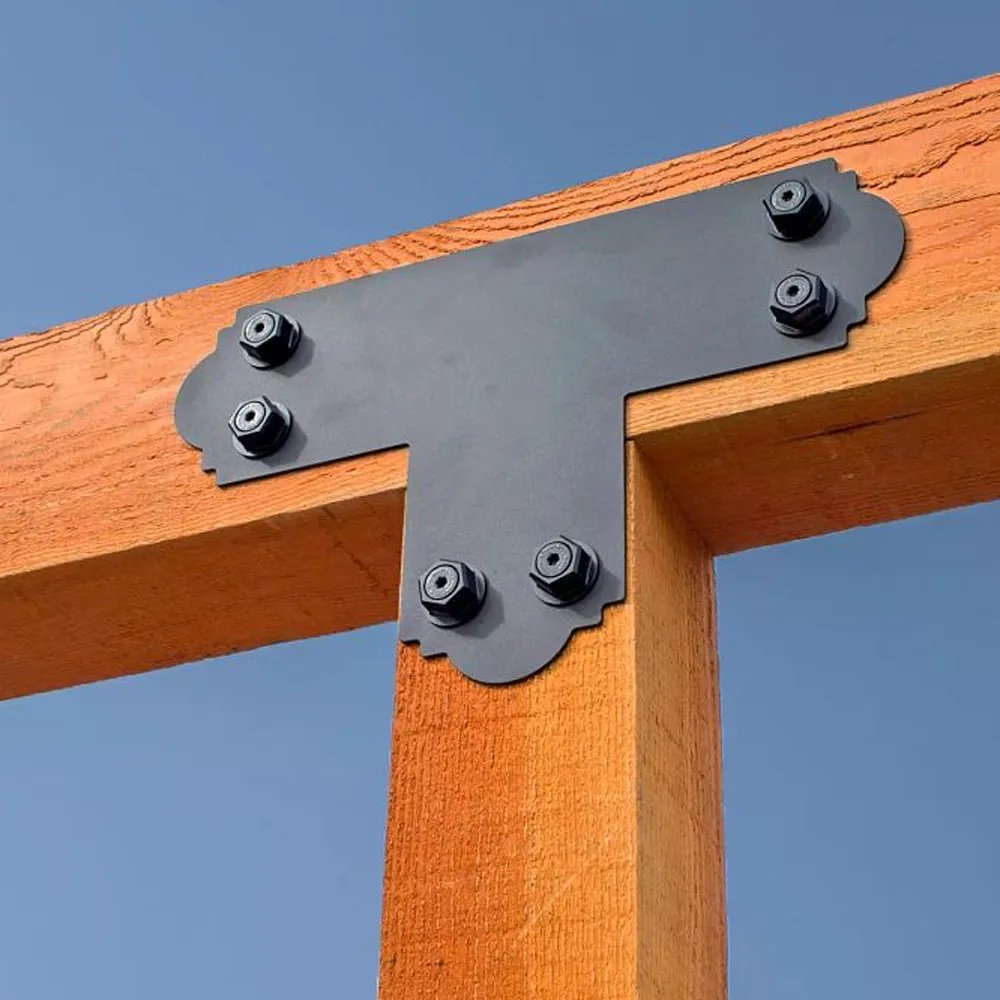
We stock the powder-coated T strap for 6×6 posts and the matching powder-coated L strap for 6×6 posts for pergola frames that need both structural connection and a finished look.
Outdoor Wood Maintenance and Hardware Inspection Schedule
Inspect hardware twice a year, in spring and fall, and after any major storm. Most hardware failures announce themselves early with rust staining, loose fasteners, or a joint that has started to gap.
| Interval | What to Check | Fix |
|---|---|---|
| Spring | Rust staining at connectors, loose bolts, wood splitting at holes | Replace stained connectors, re-torque bolts, plug and re-drill split holes |
| Fall | Post bases for standing water, coating scratches, fastener heads | Clear drainage, touch up coating, replace corroded fasteners |
| After storms | Racking, gapping joints, shifted posts | Re-check plumb, replace any deformed connector |
| Annually | Full fastener audit on load-bearing connections | Replace any fastener with visible corrosion |
For a deeper walkthrough of the corrosion side of this, our guide on preventing pergola hardware rust and corrosion covers the specific failure points and how to slow them down.
Plan Your Hardware List With a Pergola World Consultation
The hardest part of durable hardware is not picking a metal. It is building a complete, compatible list before you cut a single board, so you are not making a second trip mid-build or discovering a mismatch after the frame is up.
At Pergola World, we help homeowners and contractors build that list up front.
Get started with Pergola World and build a structure that holds its shape, its finish, and its value for years.
Frequently Asked Questions
What hardware is best for outdoor structures?
The right choice depends on exposure. For most inland decks and pergolas, ZMAX galvanized or powder-coated steel connectors with matching coated structural screws hold up well. Within about a mile of salt water, stainless steel is the safer pick because salt air attacks zinc coatings quickly. Match every fastener to the connector’s metal, and confirm the product is rated for structural use rather than general-purpose assembly.
Is stainless steel or galvanized hardware better outdoors?
Stainless steel resists corrosion longer in salt air and wet climates, but it costs more. Galvanized steel, especially ZMAX coatings paired with a powder-coat finish, handles typical inland conditions at a lower price. Many manufacturers combine coatings and base metal rather than choosing them separately.
Can pressure-treated lumber corrode metal fasteners?
Yes. Modern pressure-treated lumber often uses copper-based preservatives, and copper accelerates corrosion of standard zinc-plated and electro-galvanized fasteners. Use hot-dip galvanized, ZMAX, or stainless steel fasteners rated for treated lumber, and never mix plain deck screws with structural connectors. Check the fastener manufacturer’s compatibility chart before you buy, since treatment formulations vary by region and supplier.
How often should I inspect outdoor structure hardware?
Walk your structure once in spring and once in fall. Look for rust streaks, white powder on galvanized parts, loose bolts, and dark staining around connections, which can signal moisture trapped against the wood. Tighten anything that has backed out and replace fasteners showing red rust. Coastal homes should inspect quarterly, since salt air speeds up coating breakdown.
Can I use deck screws for structural connections?
Only if the screw is rated for structural use and the connection is engineered for screws. Standard deck screws have low shear strength and can snap under load in a ledger or beam connection. Use structural screws, lag screws, or through-bolts sized to the load, and follow the connector manufacturer’s specified fastener. When in doubt, have the connection reviewed before you build.
How do I prevent rust on outdoor structural hardware?
Start with the right metal for your exposure, then protect it. Keep connectors painted or powder-coated, touch up scratches with a matching coating, and avoid trapping water against hardware by leaving drainage gaps. Use stainless or coated fasteners with stainless or coated connectors, never mixing bare steel with coated parts. Annual cleaning with a damp cloth removes salt and dirt that hold moisture against the surface.

