

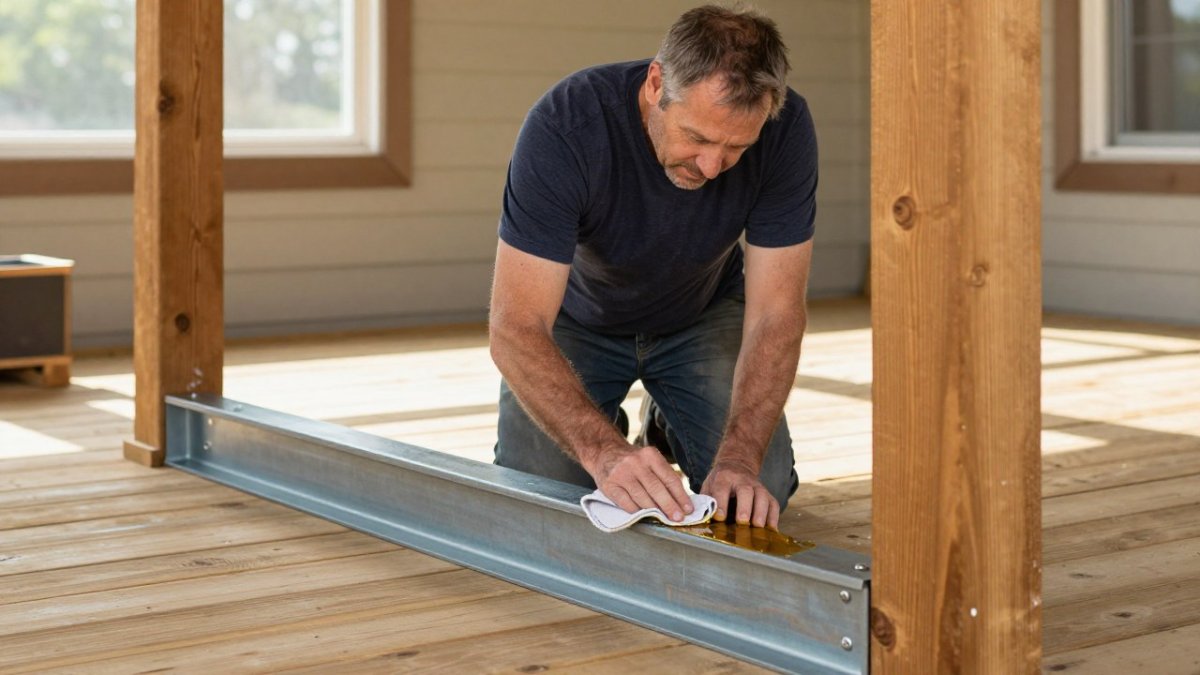
Last Updated: November 14, 2026
Quick Summary
Preventing pergola hardware rust starts with buying rated fasteners, hot-dip galvanized, ZMAX, or stainless steel, instead of thin electroplated screws. Check bolt heads, post bases, and hidden connectors monthly, and repair any rust by cleaning, treating, priming, and protecting the metal. Keep dissimilar metals isolated and touch up scratches the same day.
- Plain zinc-plated screws from bulk bins are a poor choice for permanent outdoor use.
- Grade 316 stainless is the better pick within a few miles of salt water.
- Clean, treat, prime, and protect, skip a step and rust returns within a year.
- A small stainless screw in a large aluminum plate is the worst-case galvanic pairing.
- Inspect early spring and late fall; coastal and poolside builds need a mid-summer check.
Table of Contents
- Why Pergola Hardware Rusts and How to Spot It Early
- Rust-Resistant Pergola Fasteners: What to Buy and What to Avoid
- Stainless Steel vs Galvanized Pergola Hardware: Which Lasts Longer
- How to Stop Rust on Outdoor Metal Before It Spreads
- Preventing Galvanic Corrosion Where Metal Meets Wood
- Coastal, Poolside, and High-Humidity Protection Strategies
- Your Pergola Hardware Maintenance Checklist
- Choosing Corrosion-Resistant Hardware for Your Pergola Kit
- Frequently Asked Questions
Why Pergola Hardware Rusts and How to Spot It Early
Preventing pergola hardware rust corrosion starts with understanding what causes it. Metal fasteners, brackets, and connectors fail when moisture, oxygen, and salts sit on bare or damaged metal long enough to break down the protective layer.
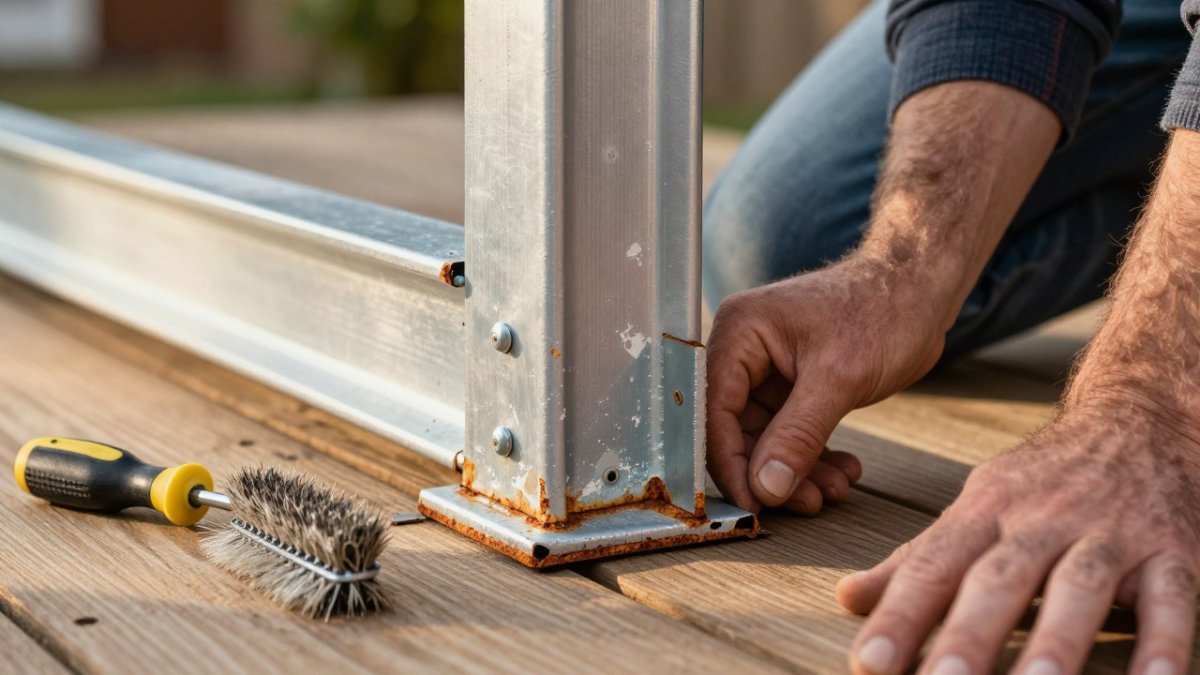
Rust rarely announces itself. It starts at edges, under bolt heads, and in seams where two pieces of metal meet. By the time it is visible from the ground, the damage has usually been working for months.
Common corrosion hotspots on metal pergola frames
Some spots corrode faster than others. Check these first:
- Bolt heads and washers where water pools after rain
- Post bases where soil, mulch, or standing water meet metal
- Joist hangers and connectors tucked under beams and out of sight
Reading the warning signs: surface rust vs. structural damage
Surface rust is a thin orange-brown film on the coating. It looks bad but the metal underneath is intact.
Structural damage is different. Look for pitting, flaking metal, a fastener that turns when it should not, or a bracket that has lost its shape.
For a broader look at how rot and rust attack pergolas, our guide on preventing pergola rot and rust covers the full picture.
Rust-Resistant Pergola Fasteners: What to Buy and What to Avoid
The single best defense against pergola hardware rust is buying the right fastener the first time. Most outdoor hardware falls into three groups: hot-dip galvanized steel, ZMAX or zinc-coated steel, and stainless steel. Each handles moisture differently, and the price gap is smaller than most people expect.
Plain zinc-plated screws sold in bulk bins are a poor choice for permanent outdoor use, since thin electroplated coatings are not built for long-term exposure.
We stock coated structural screws and connectors from brands like Simpson Strong-Tie and OZCO because the coating thickness is specified and consistent. For a concrete example of a corrosion-rated fastener, the Outdoor Accents structural wood screw in DB coating is the type of product we point customers toward for treated lumber assemblies.
Stainless Steel vs Galvanized Pergola Hardware: Which Lasts Longer
Stainless steel generally offers greater corrosion resistance, while galvanized steel is typically the lower-cost option.
Stainless steel (304 or 316 grades) resists rust across almost all outdoor conditions.
Galvanized hardware carries a zinc coating that sacrifices itself to protect the steel beneath.
| Material | Corrosion Resistance | Best For | Watch Out For |
|---|---|---|---|
| Hot-dip galvanized | High | General outdoor use | Thick coating can bind threads |
| ZMAX / zinc-coated | Good to high | Treated lumber, humid climates | Coating damage at cut edges |
| Stainless 304 | Very high | Most residential pergolas | Higher cost |
| Stainless 316 | Highest | Coastal and poolside builds | Softest of the group |
A galvanized standoff post base, like the ABA ZMAX adjustable post base, shows how a rated coating is applied to a structural connector.
How to Stop Rust on Outdoor Metal Before It Spreads
How to stop rust on outdoor metal comes down to four steps: clean, treat, prime, and protect. Skip any one and the rust comes back, usually within a year.
Start by removing loose rust with a wire brush or abrasive pad, working down to bare, sound metal. Wipe clean and let it dry fully before anything else touches it. Moisture trapped under a coating is the most common reason a repair fails.
Step-by-step repair: clean, treat, prime, and protect
- Clean the area with a wire brush or abrasive tool until loose rust is gone.
- Wipe the surface with a clean cloth and let it dry completely.
- Treat any remaining rust with a rust converter or rust-inhibiting primer.
- Prime bare metal with a primer rated for outdoor use.
- Paint with an outdoor metal paint or apply a protective coating.
- Touch up scratches, cut edges, and drilled holes the same day they happen.
Watch out: painting over rust without removing it first traps moisture and speeds up corrosion underneath. The paint flakes off within a season and takes the top layer of metal with it.
Preventing Galvanic Corrosion Where Metal Meets Wood
Galvanic corrosion is the corrosion most homeowners never see coming, because the metal that fails is often the one that looked protected. It happens when two dissimilar metals touch in the presence of an electrolyte, rain, condensation, pool splash, or humid air, and one metal becomes the anode and gives up material to protect the other.
The practical rule: the farther apart two metals are on the galvanic series, the faster the less noble one corrodes. Stainless steel and aluminum are far apart; galvanized steel and stainless are closer but still not immune; two pieces of the same alloy are effectively safe. That is why a stainless bolt threaded into an aluminum frame is a classic failure point, the aluminum becomes the anode and corrodes around the threads, often invisibly under the bolt head.
The area ratio matters more than most people realize
A small anode paired with a large cathode is the worst case: a tiny stainless screw in a large aluminum plate concentrates all the corrosion current on a small area of aluminum, and pitting can perforate the frame in a season or two in a wet, salty environment. Flip the ratio, a large galvanized bracket with small stainless fasteners, and the galvanized part becomes the anode but spreads the loss over a much larger area, so it lasts longer.
A practical compatibility framework
Use this as a selection guide, not a guarantee, coatings, sealants, and drainage still decide the outcome:
- Same-metal connections are safest. Stainless fastener in stainless bracket, galvanized fastener in galvanized connector. No galvanic couple, no accelerated loss.
- Stainless fasteners in aluminum frames need isolation. Use nylon or neoprene isolating washers and bushings, or a barrier coating at the joint. Do not rely on paint alone; it cracks at the threads.
- Galvanized brackets with stainless screws are usually acceptable inland but risky in coastal or poolside exposure. In those settings, go all-stainless or all-galvanized.
Where metal meets wood
Wood-to-metal contact is a moisture trap even when the metals match, water wicks into the joint and stays there, so the fastener sits in a wet pocket for days after rain. A bead of silicone sealant at the contact point adds a moisture barrier; a clear RTV silicone sealant is what we recommend for sealing those contact points and drilled holes.
Watch out: isolating washers and sealant slow galvanic corrosion but do not stop it if the joint stays wet. If a connection sits in a puddle, a planter, or a pool splash zone, change the detail so it drains, or switch both sides of the joint to the same corrosion-resistant alloy.
Coastal, Poolside, and High-Humidity Protection Strategies
Salt air and chlorine push corrosion into overdrive. Near the coast or beside a pool, standard galvanized hardware will not hold up the way it does inland.
Three changes make the biggest difference:
- Switch to grade 316 stainless for all fasteners and connectors
- Rinse the frame with fresh water every few weeks to wash off salt and chlorine residue
- Inspect quarterly, not annually, and touch up any coating damage immediately
Poolside pergolas face a second problem: chlorine vapor corrodes metal even without direct water contact. For coastal and humid builds, ZMAX-rated connectors, such as a ZMAX light joist hanger, give you a corrosion-rated option at a lower cost than full stainless.
Your Pergola Hardware Maintenance Checklist
A maintenance routine beats any single product choice, but only if it tells you what to look for and what to do with what you find. A frequency table alone is a calendar, not a checklist. The version below pairs each interval with the specific condition that should trigger action, so you are not guessing whether a bracket is “fine” or “failing.”
Seasonal and monthly inspection schedule
| Task | Frequency | Time Needed | Pass / Fail Criteria |
|---|---|---|---|
| Visual check of all brackets and bolts | Monthly | 5 minutes | Pass: coating intact, no orange staining. Fail: any rust bloom, peeling, or white chalky residue on aluminum |
| Tighten loose bolts and connectors | Monthly | 5 minutes | Pass: bolt holds torque. Fail: bolt spins freely or will not hold, threads may be gone |
| Rinse frame and hardware with fresh water | Monthly | 10 minutes | Pass: water sheets off. Fail: water pools at a joint or post base |
| Full inspection of post bases and hidden connectors | Seasonally | 20 minutes | Pass: no section loss, no flaking metal. Fail: pitting, flaking, or a bracket that has lost shape |
| Touch up scratches and coating damage | As found | 10 minutes | Pass: bare metal is covered same day. Fail: bare metal exposed overnight |
| Reapply protective coating | Annually | 30 minutes | Pass: coating still beads water. Fail: coating chalks, dulls, or flakes |
Time Needed
What to actually look for at each interval
Monthly checks are about catching change, not certifying perfection. Run your hand along the underside of beams where connectors hide, and look up at joist hangers from below, those two moves catch most problems before they spread.
Seasonal checks are where you find the expensive problems. Post bases sit in soil, mulch, and standing water, and they corrode from the bottom up.
When to re-coat and when to replace
Re-coating is the right call when the metal is sound and only the coating has failed. Scuff the surface, remove loose material, and apply a coating rated for outdoor metal.
Replacement is the right call when the metal itself has lost section. Pitting you can feel with a fingernail, flaking metal, a fastener that will not hold torque, or a visibly deformed bracket all mean the connection is no longer doing its job.
Seasonal timing that matches the weather
In most of the country, the two highest-value inspections are early spring and late fall. Spring catches winter damage, freeze-thaw cycles open coating cracks and drive water into joints. Fall catches summer damage, UV degradation, pool splash, and salt exposure, before winter locks it in.
Watch out: a pergola that passes a visual inspection can still be failing at the connections you cannot see.
Choosing Corrosion-Resistant Hardware for Your Pergola Kit
The right hardware choice depends on three things: your climate, your lumber, and how long you want the structure to last. Match the fastener to the exposure and the rest follows.
Match fasteners to lumber. Treated lumber needs galvanized or stainless.
Match fasteners to climate. Inland and dry conditions tolerate standard galvanized.
Match fasteners to each other. Keep dissimilar metals separated with isolators to avoid galvanic corrosion.
Pergola World offers custom-cut cedar and Douglas fir pergola kits, and expert consultations are available to help you plan your build.
Rust on pergola hardware is a maintenance problem, not a mystery.
Frequently Asked Questions
Is there something I can put on metal to prevent rust?
A rust-inhibiting primer followed by an outdoor-rated paint or powder coating creates a barrier against moisture. For exposed fasteners, a thin coat of corrosion-inhibiting spray or a wax-based protectant helps. Stainless steel hardware needs less frequent treatment, but applying a protective coating every season extends its life. Always clean the metal first so the product bonds properly.
Which hardware is best for preventing rust on a pergola?
Stainless steel, especially grade 304 or 316, offers the best corrosion resistance for most climates. Hot-dip galvanized steel is a budget-friendly alternative for inland areas. Avoid electroplated or painted hardware in coastal or poolside settings. Match fastener material to the pergola frame metal to reduce galvanic corrosion, and use isolating washers where dissimilar metals meet.
How often should pergola hardware be inspected for corrosion?
Inspect hardware at least twice a year, in spring and fall. In coastal, poolside, or high-humidity areas, check monthly during the first year and quarterly afterward. Look for surface rust, loose bolts, peeling coatings, and white powdery buildup around joints. Tighten loose connectors and touch up any scratches immediately to prevent moisture intrusion.
Can rusted pergola bolts or brackets be repaired, or should they be replaced?
Surface rust on bolts and brackets can often be cleaned with a wire brush, treated with rust converter, and repainted. Replace any hardware with deep pitting, reduced thread integrity, or structural cracks. Bolts that snap or feel loose after tightening should be swapped out. When in doubt, replace with stainless steel or galvanized hardware to restore structural integrity.

