

Last Updated: November 7, 2026
Quick Summary
Hiring contractors for pergola assembly means vetting crews on permits, insurance, and warranty before signing, then comparing itemized bids line by line. Most homeowners pay around $2,004 for construction, though the national range runs from $1,463 to $7,994. Separate labor from materials in writing so you can see which half is inflating.
- Angi puts construction at $2,105 to $6,385, averaging about $4,245 for a 100-square-foot structure.
- Homewyse prices basic wood installation at $115 to $160 per square foot.
- Score each bid 0-2 per line and treat anything below 14 of 20 as not comparable.
- Confirm who receives freight and inspects the kit on delivery, in writing, before the truck is scheduled.
- Match anchors to the surface: rated concrete anchors like Titen HD for patios, poured footings for soil.
Table of Contents
- Why Hiring Contractors for Pergola Assembly Beats a Weekend DIY Gamble
- Pergola Installation Cost: What Labor and Materials Actually Add Up To
- Kit Assembly vs. Custom Build: Which Scope Are You Hiring For?
- Questions to Ask a Pergola Contractor Before You Sign
- Permits, Property Lines, and HOA Approval: The Step Most Homeowners Skip
- Your Pergola Contractor Quote Checklist: Comparing Bids Line by Line
- Pergola Installation Timeline: From Delivery to Final Inspection
- Foundation, Anchoring, and Site Readiness Decisions
- Frequently Asked Questions
Why Hiring Contractors for Pergola Assembly Beats a Weekend DIY Gamble
Hiring contractors for pergola assembly is the decision that separates a structure still square after five winters from one that leans by the second season. According to Thumbtack’s 2026 pergola cost guide, most homeowners pay around $2,004 for construction, with the full national range running from $1,463 to $7,994. At Pergola World, we supply pre-cut cedar and Douglas fir kits to both camps, and we have watched enough projects go sideways to know the split rarely comes down to skill. Before you decide, see what the DIY route actually involves. It comes down to time, tools, and who owns the mistake when a footing lands two inches off.
Below, we’ll show you exactly how to vet, quote, and manage an assembly crew so the money you spend buys a straight structure, not a callback.
Pergola Installation Cost: What Labor and Materials Actually Add Up To
Pergola installation cost breaks into two piles: materials and labor, and the labor share surprises people. Angi’s hiring guide puts construction at $2,105 to $6,385, averaging about $4,245 for a 100-square-foot structure. Homewyse’s wood pergola estimate prices basic wood installation at $115 to $160 per square foot.
Labor generally covers layout, footing work, cutting, fastening, and cleanup, while materials cover lumber, hardware, and finishes. Ask each contractor to separate labor from materials in writing. A single lump sum hides which half is inflating.
| Cost Component | What It Covers | How to Verify |
|---|---|---|
| Labor | Layout, assembly, fastening, cleanup | Hours × rate, stated separately |
| Materials | Lumber, hardware, anchors, finish | Itemized list with brands |
| Site prep | Excavation, footings, leveling | Priced per footing or per hour |
| Disposal | Packaging and scrap removal | Flat fee or excluded |
Kit Assembly vs. Custom Build: Which Scope Are You Hiring For?
The scope question decides everything else, including who you can hire. A crew quoting kit assembly is pricing hours against a known parts list. A crew quoting a custom build is pricing design, fabrication, and site adaptation. Mixing the two in one bid comparison produces meaningless numbers.
Prefabricated Kits and Pre-Cut Lumber
Prefabricated pergola kits generally arrive with labeled parts and assembly instructions, which can simplify the labor estimate. Pre-cut profile ends and pre-stained lumber, where offered, can reduce finishing steps. If your space has an odd corner, see how custom pergola kits handle non-standard dimensions before you assume modification is required.
Custom and Site-Built Structures
Custom pergola work generally involves drawings, material selection, and on-site fitting, and two builders can interpret the same sketch differently. Get the drawing attached to the contract so the bid has a fixed reference point.
Questions to Ask a Pergola Contractor Before You Sign
The best pergola contractor answers scope, insurance, and warranty questions without flinching. Ask these before money moves:
- Who pulls the permit, and is it in the bid?
- Can I see your certificate of insurance for general liability and workers’ comp?
- How many pergolas have you assembled in the last 12 months?
- What happens if a footing lands off-mark?
- Is your workmanship warranty separate from the manufacturer’s product warranty?
- Who handles freight delivery and staging?
- What’s your plan for anchoring into my specific surface?
Vague answers on any of these are your signal to walk. A contractor who has done this work has stock answers ready.
Permits, Property Lines, and HOA Approval: The Step Most Homeowners Skip
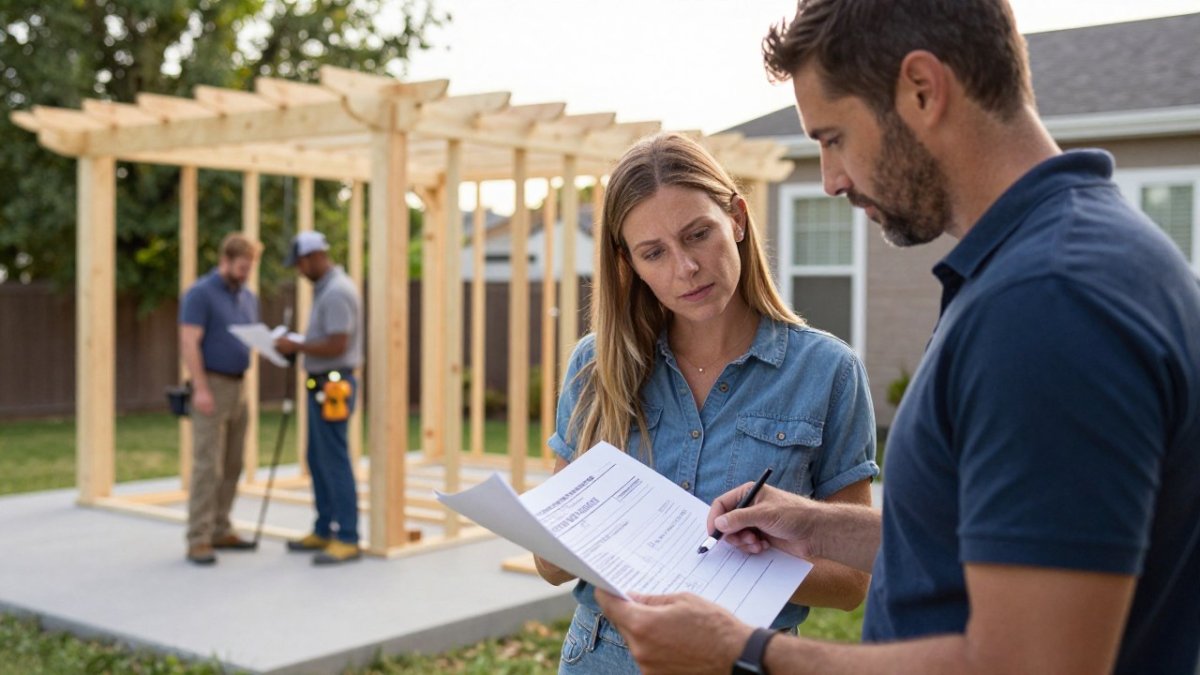
Permits and HOA approval are the step that stalls more pergola projects than any other, and it belongs to you, not the crew. Most jurisdictions classify a pergola as an accessory structure, which triggers setback rules from property lines and sometimes height limits. HOA covenants can be stricter than the city code.
Check three things before signing: your local building department’s accessory structure requirements, your plat or survey for exact setback distances, and your HOA’s architectural review process. Get approval in writing. A crew that starts framing before the HOA signs off can be ordered to stop, and you eat that cost.
Your Pergola Contractor Quote Checklist: Comparing Bids Line by Line
A pergola contractor quote checklist turns three confusing bids into one clear decision, but only if you score every bid against the same lines and understand what each line is hiding. The worksheet below goes further: it tells you what a fair entry looks like, what a red flag looks like, and how to normalize bids that were written to different scopes.
Score each bid on a 0-2 scale per line (0 = missing or vague, 1 = stated but incomplete, 2 = itemized and specific). A bid that scores below 14 of 20 on assembly-relevant lines is not comparable, no matter how low the total.
| Quote Line | What a Strong Entry Looks Like | Red Flag |
|---|---|---|
| Labor | Hours × rate, or a fixed labor price tied to the kit’s part count | One lump sum covering labor and materials |
| Materials | Itemized list with brands (e.g., Simpson Strong-Tie, OZCO) and quantities | “Anchors and hardware included” with no names |
| Kit delivery and freight | Freight charge shown separately, with liftgate or curbside noted | Delivery “included” but no access or staging detail |
| Site preparation | Excavation, leveling, and footing work priced per footing or per hour | Site prep omitted entirely |
| Footings | Quantity, diameter, and depth stated | “Footings as needed” |
| Anchoring | Anchor type matched to surface (concrete vs. soil) | Generic “anchors” line |
| Disposal | Packaging, scrap, and old-structure removal as a flat fee or explicit exclusion | Silent on disposal |
| Permit fees | Listed, or explicitly excluded with who pulls it | No mention of permits |
| Workmanship warranty | Term in writing, separate from the manufacturer’s product warranty | “Warranted” with no term |
| Payment schedule | Tied to milestones (footings set, frame complete, final walkthrough) | Large deposit before delivery |
| Start and completion dates | Calendar dates with weather-delay language | “Spring timeframe” |
Two bids at the same total can differ underneath. One may include footings and the other not. One may name rated concrete anchors and the other simply say “anchors.” Warranty terms also vary, so confirm the length in writing. Compare line by line, and the low bid often stops looking low.
Normalize before you compare. If Bid A excludes footings and Bid B includes them, ask Bid A to price footings as a line item so both bids cover the same scope. Do the same for freight, disposal, and permit fees. A contractor who resists itemizing is telling you something about how change orders will go later.
Watch out: a quote that bundles “miscellaneous” or “shop supplies” into a percentage of the total is where overruns hide, ask for that line to be capped or removed.
Pergola Installation Timeline: From Delivery to Final Inspection
Pergola installation timeline depends on scope, site readiness, and weather, but the sequence stays consistent, and the delays almost always come from things the homeowner controls before the crew arrives. Most guides give you a phase table and stop.
Most single-structure projects follow this path:
| Phase | Typical Duration | What Happens | Who Owns the Handoff |
|---|---|---|---|
| Pre-build approvals | 1-4 weeks (varies widely) | Permit issued, HOA approval in writing | Homeowner |
| Kit delivery and staging | 1-2 hours | Freight arrives, parts checked against packing list | Homeowner or contractor (confirm in contract) |
| Layout and marking | 2-4 hours | Corners squared, footing locations marked, utilities located | Contractor |
| Footings and anchoring | 1-2 days | Holes dug, concrete set or anchors driven | Contractor |
| Frame assembly | 1-2 days | Posts, beams, rafters fastened | Contractor |
| Finish and cleanup | Half day | Final fastening, inspection, debris removal | Contractor |
Weather and inspection scheduling add days. Build slack into your expectations, and confirm who is responsible for the final inspection walkthrough.
What to prepare before the crew arrives. Clear the work area and a path for carrying posts and beams. Confirm gate width and overhead clearance against the longest kit part, a beam that won’t fit through the side yard stops the job on day one.
Kit delivery is a schedule risk, not a formality. Freight carriers may deliver curbside, and a residential street with no turnaround can push delivery to a later window.
Weather and inspection delays. Concrete footings need cure time before framing loads them, and cold or wet weather stretches that window. Inspection scheduling can add days depending on your jurisdiction’s backlog. A realistic schedule includes buffer for both, and a contractor who quotes a hard completion date without weather language is quoting something they can’t control.
Watch out: if the contract doesn’t say who receives the freight and inspects the kit on delivery, damage discovered during assembly can become your problem, confirm that handoff in writing before the truck is scheduled.
Foundation, Anchoring, and Site Readiness Decisions
Anchoring is where assembly-specific risk concentrates. A pergola is exposed to wind load, which transfers into the base connections. On a concrete patio, that generally means rated anchors set to the manufacturer’s specified embedment depth. On soil, it means footings below frost line where your code requires it.
Match the anchor to the surface, not to whatever is in the truck. Heavy-duty screw anchors like Titen HD 1/2 in. x 5 in. mechanically galvanized anchors are built for concrete, while soil applications need poured footings. If your ground slopes, follow a step-by-step guide for installing pergola kits on uneven ground so leveling happens before assembly, not after. Setting on a patio? Read the concrete installation walkthrough for surface-specific anchoring steps.
Watch out: skipping a site check for buried irrigation lines and utility runs is the mistake that turns a footing hole into a repair bill.
The difference between a pergola that lasts and one that wobbles comes down to the crew you hire and the materials they assemble. At Pergola World, we supply custom-cut cedar and Douglas fir kits, optional pre-cut profile ends and pre-stained lumber for faster assembly, and hardware from brands like Simpson Strong-Tie and OZCO, plus design consultations to help you or your contractor plan the build.
Frequently Asked Questions
How much does it cost to hire someone to build a pergola?
Costs vary widely by size, material, and region. Costs depend on size, material, and region, so ask each contractor for a line-item breakdown of labor and materials before comparing bids.
How long does it take to assemble a pergola?
Timelines depend on site preparation, delivery, weather, and whether permits are required, so ask your contractor for a written schedule. The pergola installation timeline depends on site prep, delivery lead time, and whether permits are required. Ask your contractor for a written schedule that separates demolition or site work, footing cure time, frame assembly, and cleanup so you can plan around it.
Does pergola assembly include anchoring the posts to concrete?
Not always, and this is one of the most common gaps in a pergola contractor quote. Anchoring to a concrete slab or footings requires specific hardware, such as post bases and structural screws, and may require drilling and epoxy. Confirm in writing whether the bid includes footings, base hardware, and anchoring, and who supplies the connectors. If you are providing a kit, check whether the hardware is included or must be purchased separately.
Do I need a permit to install a pergola?
Permit rules depend on your local building department, the structure’s size, and whether it is attached to your home or freestanding. Many jurisdictions require a permit for structures above a certain height or square footage, and HOAs often have separate approval processes covering setbacks, colors, and property lines. Ask your contractor whether they handle permit applications, and confirm who pays the fees. Get HOA approval in writing before any materials are delivered.

