

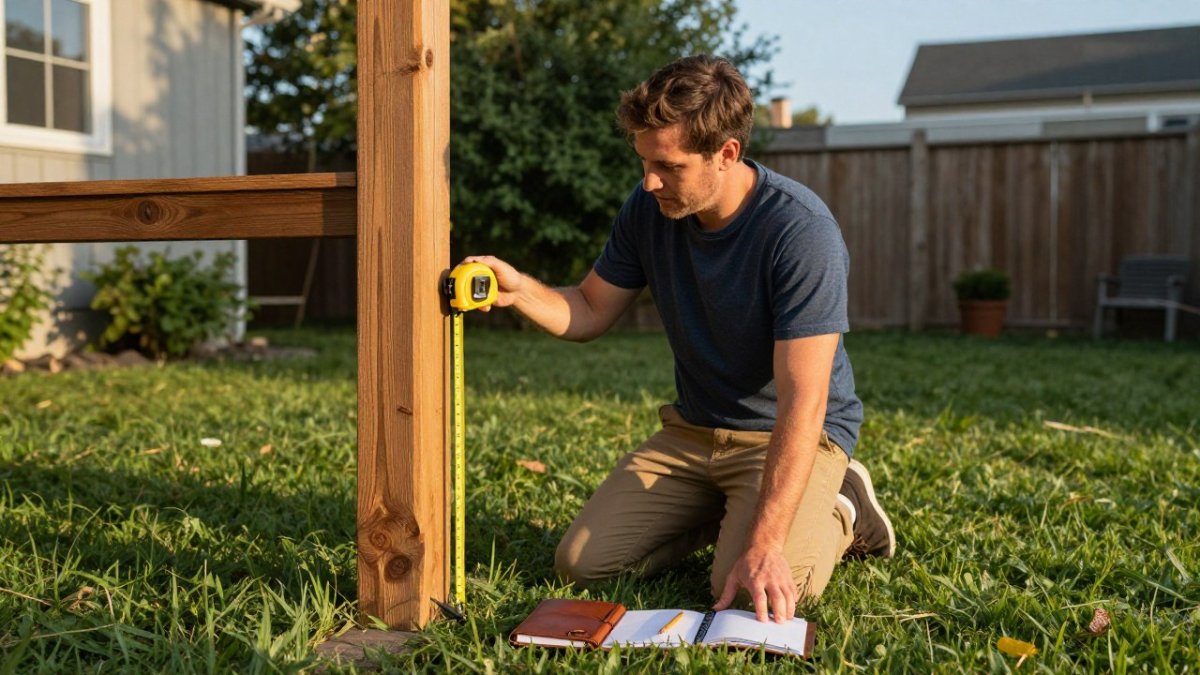
Last Updated: November 17, 2026
Quick Summary
To measure backyard dimensions accurately, sketch the yard, then measure each side with a tape at ground level, writing every number in feet with decimals. Measure each side twice, add all four sides for perimeter, and multiply length by width for square footage. Confirm any satellite or paced estimate with a tape before ordering materials.
- Calibrate your step on a 20-foot line, then divide 20 by your average step count.
- One acre equals 43,560 square feet, so a 1,200-square-foot yard is about 0.028 acres.
- For slopes, measure the horizontal distance with the tape held level, not along the ground.
- Subtract obstacle footprints: a 10 x 12 shed removes 120 square feet from usable area.
- On a 40-foot side, a 3-foot error changes a 1,200-square-foot rectangle by roughly 180 square feet.
Table of Contents
- Before You Measure: Tools, Units, and a Simple Sketch
- How to Measure a Yard by Walking
- Using Google Maps to Measure My Lawn
- Tape Measure Method: Length, Width, and Perimeter
- How to Calculate Yard Square Footage
- How to Measure Backyard Dimensions Calculator Options
- Handling Slopes, Obstacles, and Multi-Level Yards
- Checking Your Numbers: Accuracy and Imagery Limits
- Frequently Asked Questions
Before You Measure: Tools, Units, and a Simple Sketch
Getting accurate backyard dimensions starts before you touch a tape. You need three things: the right tools, one consistent unit of measurement, and a rough sketch of your yard’s shape.
Here’s what to gather:
- A 100-foot tape measure (longer is better for big lots)
- A 25-foot tape for short spans and obstacles
- Stakes or landscape flags to mark corners
- A notepad and pencil, or a phone for notes
- A helper for long stretches
Pick one unit and stick with it. In the U.S., feet and inches are standard. Convert everything to feet before you calculate. A yard that’s 20 feet 6 inches wide becomes 20.5 feet.
Now sketch the yard from above. Draw the house wall, fence lines, garden beds, and anything permanent like a shed or tree. Don’t worry about scale. You just need the shape.
Watch out: Mixing feet and inches mid-project is the fastest way to miscalculate square footage. Write every number in feet with decimals, never in feet-and-inches shorthand.
How to Measure a Yard by Walking
Walking off a yard is the fastest way to get a rough footprint, and it doubles as a calibration step you can reuse on every later measurement.
Calibrate your step first. Mark a 20-foot line on a flat driveway or sidewalk with a tape.
Here is how to pace off a yard:
- Walk a straight line from one boundary to the opposite side at a steady, natural pace.
- Count every step, including the first and last.
- Multiply steps by your pace factor to get approximate feet.
- Repeat the same line in the opposite direction and average the two counts.
- Do the same for the perpendicular dimension.
- Multiply length by width for a rough area.
Worked example. A yard paces out at 16 steps one way and 15 the other, averaging 15.5. At a 2.5-foot pace factor that is about 38.75 feet.
Pacing works best on flat, open lawn. It drifts on slopes, around obstacles, and on irregular shapes, and it is only as good as your calibration.
Watch out: Pacing a long side in one pass compounds small step errors.
Use the walk-through for planning, not purchasing.
Using Google Maps to Measure My Lawn
Google Maps and Google Earth both offer distance tools you can use to trace a lawn boundary. The process is quick, but the accuracy depends on image quality and how carefully you click.
To use Google Maps to measure my lawn, follow these steps:
- Open Google Maps and switch to satellite view
- Search your address or zoom to your property
- Right-click a starting corner and choose “Measure distance”
- Click each corner of your lawn to trace the outline
- Read the total distance for perimeter, or close the shape to estimate area
Google Earth works the same way with its ruler tool. The benefit is speed: you can trace an irregular boundary in a minute. The catch is imagery resolution. Older satellite photos, tree cover, and shadows can throw off your clicks by several feet.
For planning purposes, satellite tools are a good starting point. For anything structural, confirm with a tape. And if you’d rather not type your home address into a mapping tool, the tape measure method below keeps your information private.
Tape Measure Method: Length, Width, and Perimeter
The tape measure is still the most reliable way to measure backyard dimensions. It’s slower than satellite tools, but it gives you numbers you can trust.
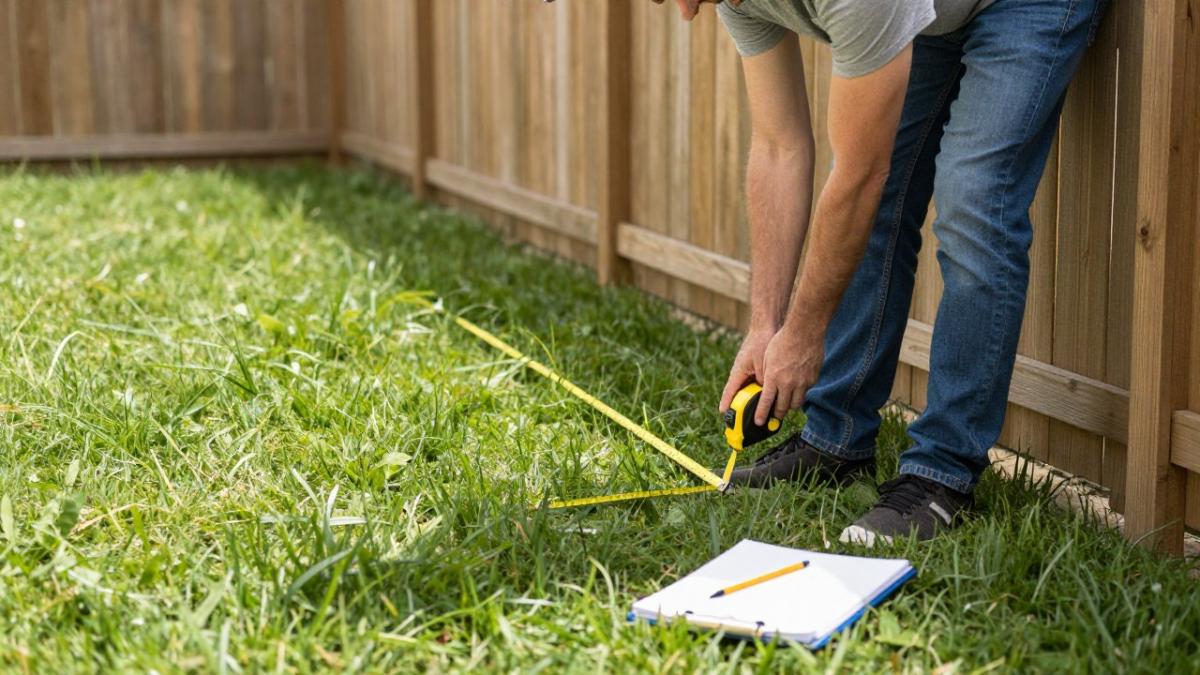
Start with the longest side. Hook the tape on one corner, have a helper hold it, and walk it to the opposite corner. Write the number down immediately. Then measure the width the same way.
For perimeter, add all four sides. A 40-foot by 30-foot yard has a perimeter of 140 feet. Perimeter matters for fencing, edging, and linear features. Area matters for grass seed, sod, and structures.
A few practical tips:
- Measure at ground level, not along a fence that leans
- Pull the tape taut but don’t stretch it
- Measure each side twice to catch errors
- Note any jogs or bump-outs in the boundary
If your yard has a fence that isn’t square to the house, measure the actual fence lines, not the house lines. The fence defines your usable space.
How to Calculate Yard Square Footage
Square footage is length times width for a rectangle. That’s the whole formula. The complexity comes from irregular shapes and unit conversions.
Rectangles, Triangles, and Irregular Shapes
- Rectangle: length × width. A 40 × 30 yard is 1,200 square feet.
- Triangle: (base × height) ÷ 2. A garden bed with a 20-foot base and 10-foot height is 100 square feet.
- L-shape: split it into two rectangles, calculate each, then add them.
- Irregular shape: break it into rectangles and triangles, calculate each piece, and total them.
For curved beds, approximate with a series of narrow rectangles or use the average of several width measurements. You won’t get perfect precision, but you’ll get close enough for seed and sod.
Converting Square Feet to Acres and Square Meters
One acre equals 43,560 square feet (U.S. Survey Foot: Revised Unit Conversion Factors | NIST). So a 1,200-square-foot yard is about 0.028 acres. To convert square feet to square meters, multiply by 0.0929. A 1,200-square-foot yard is roughly 111 square meters.
Keep a conversion cheat sheet handy:
| From | To | Multiply by |
|---|---|---|
| Square feet | Acres | 0.00002296 |
| Square feet | Square meters | 0.0929 |
| Acres | Square feet | 43,560 |
| Linear feet | Meters | 0.3048 |
Once you know your square footage, you can see how that number feeds into a project budget with our guide on how to calculate pergola kit costs.
How to Measure Backyard Dimensions Calculator Options
A calculator only multiplies the numbers you give it, so the real work is deciding which tool produces trustworthy inputs for your yard’s shape. Use this decision framework instead of picking an app at random.
Match the tool to the shape and the stakes:
- Simple rectangle, planning only: an online area calculator or a spreadsheet formula (length × width) is enough. Enter feet with decimals, not feet-and-inches.
- Irregular outline, planning only: a mapping tool that lets you trace the boundary and close the shape is faster than breaking the yard into pieces by hand.
- Anything you will build on or order materials for: measure with a tape, then let a calculator or spreadsheet handle the arithmetic. Do not let an app’s area figure stand in for ground measurements.
- Sloped or multi-level yard: no single calculator handles this well. Measure each level separately, calculate each, and add the totals.
A tool-independent workflow that works with any of them:
- Sketch the yard and label every side and corner.
- Measure or trace each side, writing the number next to its label.
- Break irregular areas into rectangles and triangles on the sketch.
- Enter each piece into the calculator or spreadsheet separately.
- Total the pieces, then subtract obstacles like sheds, patios, and beds.
- Cross-check the total against a second method, a paced estimate or a satellite trace, before you rely on it.
Worked example. An L-shaped yard splits into a 40 × 30 rectangle (1,200 square feet) and a 15 × 20 rectangle (300 square feet), for 1,500 square feet.
Accuracy checks for any calculator:
- Confirm every side length in the tool’s measurement list looks plausible before trusting the area.
- Re-enter one dimension a second way and see if the total moves; if it does, find the error.
- Compare the calculator total against a tape-measured rectangle of the same footprint.
- Round the final figure to the nearest 10 square feet for planning, and keep the unrounded number for material orders.
Watch out: Mapping apps and GPS-based measurement tools can be off by several feet on small yards because of imagery resolution and signal drift.
Once you have a verified square footage, you can carry that number into project planning, including our guide on how to calculate pergola kit costs.
Handling Slopes, Obstacles, and Multi-Level Yards
Sloped and cluttered yards break the simple length × width formula.
For slopes, measure the horizontal distance, not the distance along the ground. Hold the tape level and drop a plumb line at each end.
For obstacles like trees, sheds, and garden beds, measure the full rectangle first, then subtract the obstacle’s footprint.
Multi-level yards need separate measurements for each level. Treat each flat area as its own shape, calculate each, then add them.
If you’re planning to build on uneven ground, our step-by-step guide on how to level a pergola frame walks through the process for sloped sites.
Watch out: Measuring along a slope instead of level can add several feet to a long span. On a steep yard, that error compounds fast.
Checking Your Numbers: Accuracy and Imagery Limits
Every measurement method has limits. Knowing them keeps small errors from becoming expensive ones.
Satellite imagery has three main limits:
- Resolution: older photos may be blurry at the property line
- Date: images can be years old, before that fence or shed existed
- Obstruction: tree canopy and shadows hide boundaries
Tape measures have their own limits: long spans sag, wind moves the tape, and helpers drift off line. Measure long distances in shorter segments and add them up.
A simple error check: measure the same side twice, ideally on different days. If the numbers match within a few inches, you’re good. If they don’t, find out why before you order materials.
Here’s a quick self-check before you finalize your numbers:
- Every side measured twice
- All numbers converted to feet with decimals
- Obstacles subtracted from usable area
- Slopes measured level, not along the ground
- Satellite estimate compared against tape measurement
When you’re ready to turn those numbers into a structure, Pergola World offers custom-cut cedar and Douglas fir lumber, with optional pre-cut profile ends and pre-stained lumber.
Measuring a backyard accurately takes patience, but the payoff is a project that fits the first time.
Frequently Asked Questions
How do I find out the dimensions of my backyard?
Start with the tape measure method for the most reliable numbers. Measure the length and width of each straight section along the fence line, then multiply length by width to get square footage for each section. For a quick estimate first, trace the boundary in Google Maps or walk the perimeter and count your steps. Compare two methods before you buy materials, since satellite imagery can be off by several feet on heavily treed lots.
Can Google Maps tell me the size of my yard?
Yes, Google Maps and Google Earth both include a distance and area tool that lets you trace your property boundary or lawn outline and read the square footage. It works well for open, flat yards with clear fence lines. Accuracy drops where tree canopy hides the ground, where boundaries are unclear, or where the yard slopes. Use the map result as a planning figure and confirm with a tape measure before ordering lumber or a pergola kit.
How do I measure an irregularly shaped backyard?
Break the yard into simple shapes. Split it into rectangles, right triangles, and circles, measure each one separately, then add the results together. For a triangle, multiply base by height and divide by two. For a curved garden bed, measure the widest and narrowest points and average them. Sketch the yard on paper first and label each section so you do not double count overlapping areas.
How can I measure my backyard with my phone?
Open Google Maps on your phone, drop a pin at one corner of the yard, and use the measure distance tool to tap each boundary point around the outline. The app returns both perimeter and enclosed area. Stand still while tapping so GPS drift does not skew the line. For small features like a patio pad or pergola footprint, a tape measure or a laser measure is more precise than phone GPS, which can wander several feet.

