

Last Updated: October 25, 2026
Quick Summary
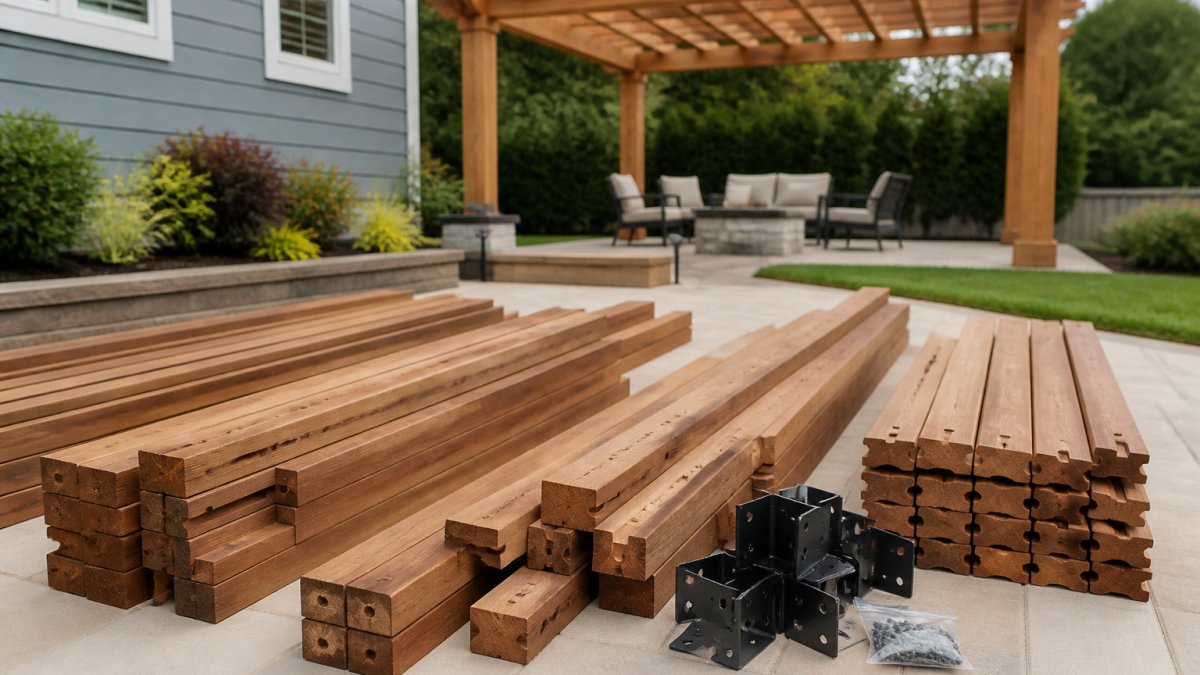
A Pergola Kits USA alternative changes who cuts the lumber, not the kit model itself. Instead of a fixed-size box from a standard retailer, an alternative supplier cuts pergola kits to your dimensions, lumber species, and hardware spec. Compare delivered-and-installed cost, not sticker price.
- Judge suppliers on lumber species, cut tolerance, hardware spec, profile prep, freight terms, and replacement parts.
- Custom cutting adds lead time before freight, so plan around it rather than against it.
- Cedar resists moisture and insects naturally; Douglas fir is denser but needs more protection in wet climates.
- Sketch post positions with door swings, hot tub, and slab edge, then send the sketch with your order.
- Freight is the sleeper line item, so ask for a delivered quote to your ZIP code first.
Table of Contents
- What a Pergola Kits USA Alternative Actually Changes
- How Top Pergola Kit Options Compare on Price and Specs
- Custom Pergola Kits: Sizing a Structure to Your Patio
- Cedar Pergola Kits: Why the Lumber Species Matters
- Pergola Kits for Irregular Shapes: Corners, L-Shapes, and Odd Angles
- Pergola Kit Installation: DIY, Contractor, or Hybrid
- Total Cost of Ownership: What the Sticker Price Leaves Out
- Get a Free Estimate on a Custom-Cut Kit
- Frequently Asked Questions
What a Pergola Kits USA Alternative Actually Changes
The North American pergola kits market was estimated at USD 89.3 million in 2022 and was expected to grow at a 5.3% CAGR through 2030, according to Grand View Research’s pergola kits market analysis. That growth tells you something useful: buyers are actively shopping, and they are comparing. A pergola kits usa alternative is not about abandoning the kit model. It is about changing who cuts the lumber and how much of the project you outsource.
The core shift is this: a standard retailer ships you a fixed-size box. An alternative supplier cuts to your dimensions, your lumber species, and your hardware spec.
Where Standard Kit Retailers Fall Short
Standard kit retailers compete on catalog size, not fit. Most sell a handful of nominal sizes, and the frame either lands short of your patio edge or overhangs it. Hardware is often the cheapest bracket that passes a load test. Shipping is frequently a separate line item that arrives as a surprise.
Watch out: a “free shipping” banner usually means freight is baked into the unit price, so compare delivered totals, not sticker prices.
Pre-cut profiles solve the slowest part of assembly, the measuring and re-cutting. Benefits of pre-cut pergola profiles for faster builds shows how they address the shortcomings of standard kits. That is the gap Pergola World’s guide to pre-cut pergola profiles addresses.
The Criteria That Separate Kit Suppliers
Judge any supplier on six things, in this order:
| Criterion | What to Check | Why It Matters |
|---|---|---|
| Lumber species | Cedar, Douglas fir, or unspecified “wood” | Rot resistance and dimensional stability |
| Cut tolerance | Custom-cut vs. fixed nominal sizes | Whether the frame fits your patio |
| Hardware spec | Named brands vs. generic brackets | Corrosion life and load ratings |
| Profile prep | Pre-cut ends, pre-stained options | Hours saved during assembly |
| Freight terms | Delivered price vs. separate freight | Real total cost |
| Replacement parts | Availability years after purchase | Long-term support |
A supplier that cannot answer all six in writing is a supplier you should not wire money to.
How Top Pergola Kit Options Compare on Price and Specs
Pricing across the category varies widely, and published figures are thin. One 2026 comparison guide puts kit pricing starting at USD 4,549, per Rinova Pergola’s brand comparison. A Better Homes & Gardens roundup lists the Backyard Discovery Beaumont Pergola at $1,699 at Home Depot, and a Mirador 111DA 10-by-10-foot model from $2,399.
Those numbers are not apples to apples. They cover different sizes, materials, and included accessories. The Beaumont listing does not state dimensions or warranty in the source material. The Mirador listing does not specify material or accessories.
Here is the comparison as the research supports it:
| Option | Listed Price | Size / Notes | Best For |
|---|---|---|---|
| Backyard Discovery Beaumont | $1,699 | Kit; dims not stated in source | Budget-minded fixed-size buyers |
| Mirador 111DA | From $2,399 | 10 x 10 ft | Shoppers wanting a priced mid-size kit |
| Purple Leaf Retractable | Not stated | Retractable design | Buyers wanting adjustable shade |
| Custom-cut kits | Quote-based | Cut to your dimensions | Non-standard patios and species choice |
For a broader benchmark across top kits, see our comparison of the best pergola kits.
Custom Pergola Kits: Sizing a Structure to Your Patio
Custom pergola kits are kits cut to your actual measurements rather than a nominal catalog size, which means the frame lands where you want it instead of where the box allows. That matters most on patios with a fixed slab edge, a hot tub, or a door swing to clear.
The trade-off is lead time. Custom cutting adds days before freight, so plan around it rather than against it.
If your project needs dimensions the catalog does not carry, you can explore custom pergola kits cut to your patio’s measurements.
Cedar Pergola Kits: Why the Lumber Species Matters
Cedar pergola kits use a lumber species with natural resistance to moisture and insects, which is why cedar shows up in outdoor structures more than most softwoods.
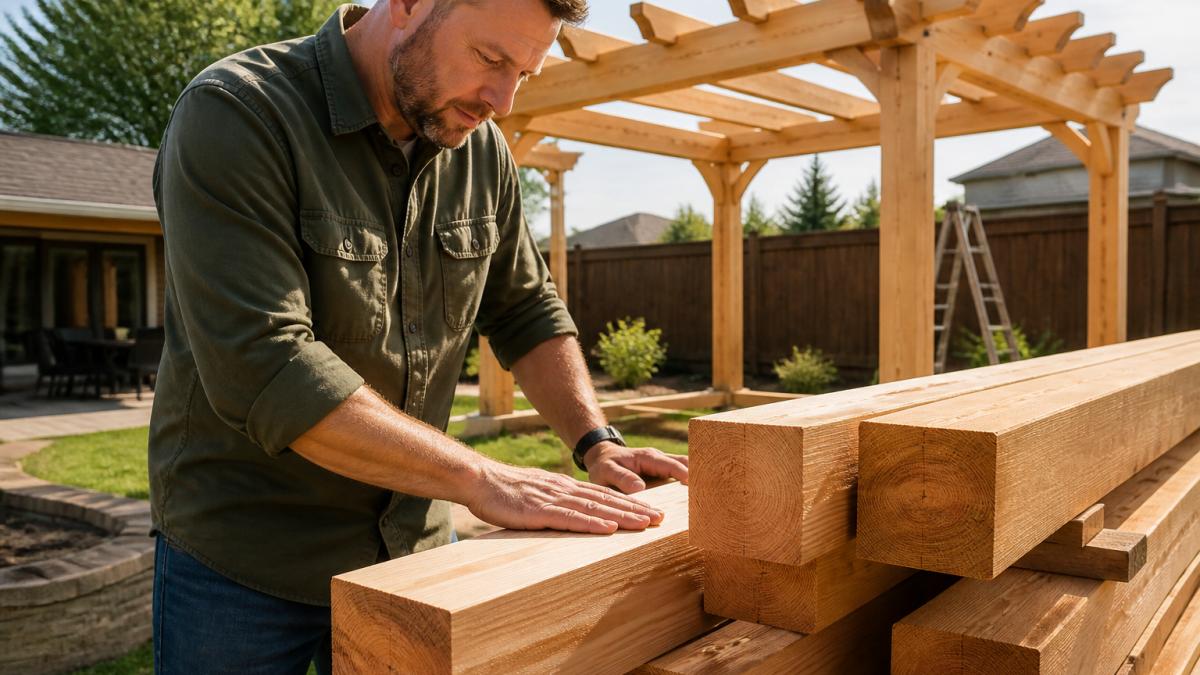
Pergola Depot’s material comparison notes that wood offers a look that blends more naturally with outdoor surroundings than aluminum. That is the honest case for wood: appearance and warmth, at the cost of periodic sealing.
Heartland Pergolas makes a related point for vinyl with aluminum reinforcement, describing it as durable and low-maintenance. Different trade-off, same decision framework.
Pergola Kits for Irregular Shapes: Corners, L-Shapes, and Odd Angles
Pergola kits for irregular shapes are the hardest category to buy off the shelf. Corner configurations, L-shapes, and triangular footprints all break the rectangular assumption baked into standard kits. An L-shape needs two connected spans with a shared post line. A corner unit needs a wall attachment that carries load correctly.
No single national rule makes a pergola permit-free below a certain size. Bloom Cabin’s permit guide is explicit that requirements depend on local rules, so check with your local building department before you order.
Measure the footprint, sketch the post positions, and send the sketch with the order. That single step prevents most of the modification work buyers complain about.
Pergola Kit Installation: DIY, Contractor, or Hybrid
Installation difficulty is not a property of the kit.
Full DIY. You set and brace the posts, level the frame, and fasten the hardware. This is the cheapest on labor and the slowest on calendar time.
Hybrid. You handle site prep, layout, and material staging; a contractor sets the posts and the frame.
Full contractor. You hand over the kit and the labor. Pergola Cave’s DIY vs. professional guide frames professional assembly as a way to avoid DIY challenges while keeping savings over custom construction.
Anchoring is where the paths diverge most, and it is the step most often underspecified in listings.
- Slab-mounted: posts are anchored through base plates into the concrete with wedge anchors or similar, and the slab thickness and reinforcement determine whether that is adequate. Our step-by-step concrete installation guide covers the anchor sequence.
- Ground-mounted: posts are set below frost line in footings sized to your local code, then braced until the concrete cures. This is the path where a contractor earns the fee.
- Wall-attached and corner units: the ledger or wall attachment carries load and must be fastened to structure, not siding. This is the detail that fails inspection most often.
Permits are a sequencing issue, not a paperwork issue. No single national rule makes a pergola permit-free below a certain size. Bloom Cabin’s permit guide is explicit that requirements depend on local rules, so check with your local building department before you order, not after the kit arrives.
Before you choose a path, sketch the post positions on the actual footprint and mark the door swings, the hot tub, and the slab edge. Send that sketch with the order. It prevents most of the modification work buyers complain about, and it tells you in advance whether the job is a weekend or a contractor call.
The honest decision rule: if the site is a flat, sound slab and the kit is pre-cut, full DIY is realistic for a careful homeowner. If the site is sloped, the posts need footings, or the unit attaches to the house, price the hybrid or full-contractor path before you buy the kit, because those costs belong in the total cost comparison, not in a surprise invoice later.
Total Cost of Ownership: What the Sticker Price Leaves Out
Sticker price is the least useful number in this category.
| Cost line | Prefabricated kit | Custom-cut kit | Lumber-and-hardware build |
|---|---|---|---|
| Frame material | Bundled in unit price | Quoted by species and dimension | Board-foot pricing at the yard |
| Hardware | Often generic brackets; upgrade may be extra | Specified at order (e.g., Simpson Strong-Tie, OZCO) | Bought separately; easy to under-buy |
| Freight | Frequently a separate line; long lumber ships freight-class | Quoted with the kit; lead time added | You haul or pay delivery per trip |
| Cutting and milling | Pre-cut; no saw time | Pre-cut to your dimensions | You cut, or pay a mill |
| Finishing | Raw or pre-stained (upcharge) | Pre-stained option at order | Stain and sealer bought separately |
| Tools | Basic drill and wrench | Basic drill and wrench | Saw, jig, and layout tools if not owned |
| Installation | DIY, hybrid, or contractor | DIY, hybrid, or contractor | Same three paths, more labor hours |
Two patterns are worth naming because they drive most of the variance.
Freight is the sleeper line item. Long lumber and bundled posts ship as freight, not parcel, and freight quotes depend on class, distance, and whether the carrier can reach your curb.
A common pattern among buyers who regret a purchase is that they compared sticker prices across different sizes and materials.
For the freight side specifically, our guide to avoiding high pergola freight costs explains how to read a freight quote before you commit.
Get a Free Estimate on a Custom-Cut Kit
Comparing pergola kits gets easier once you know your dimensions, your species, and your hardware spec. The hard part is finding a supplier who will cut to all three without treating your patio as an exception.
At Pergola World, we cut cedar and Douglas fir to your measurements, offer pre-cut profile ends and pre-stained lumber to shorten assembly, and supply hardware from Simpson Strong-Tie and OZCO. Our design consultations walk through layout before anything ships. Get started with Pergola World and get a free estimate on a kit built to your patio.
Frequently Asked Questions
What are the best alternatives to Pergola Kits USA?
The strongest alternatives are suppliers that cut lumber to your dimensions rather than selling fixed-size boxes. Look for custom-cut cedar or Douglas fir, hardware from established brands like Simpson Strong-Tie and OZCO, and pre-stained or pre-cut profile options that shorten assembly. Pergola World builds kits this way and also offers design consultations for odd-shaped patios. Compare each supplier on material grade, hardware brand, lead time, and whether the kit ships with a cut list matched to your site.
How do pergola kit brands compare for quality and ease of assembly?
Quality usually comes down to three things: lumber species and grade, connector hardware, and how precisely pieces are cut. Cedar pergola kits resist rot and insects without chemical treatment, while pressure-treated pine costs less but needs sealing. Hardware from names like Simpson Strong-Tie and OZCO holds up better than generic brackets. Ease of assembly depends on pre-cut profiles and pre-drilled holes; kits with labeled, numbered parts and a clear cut list go together faster and with fewer mistakes.
Are cedar pergola kits better than pressure-treated wood kits?
Cedar wins on appearance and natural rot resistance, and it holds stain well, which matters if you want a finished look without annual resealing. Pressure-treated lumber costs less upfront and is widely available, but it can warp and check as it dries and needs periodic sealing to last. For a structure you plan to keep for 15 or more years and see every day from the house, cedar pergola kits usually justify the higher material cost.
Can I get a custom-sized pergola kit?
Yes. Custom pergola kits are cut to your dimensions rather than trimmed on site. Measure the patio footprint, note any walls or fences the structure must clear, and confirm post spacing. A supplier that pre-cuts rafters, beams, and posts to your numbers removes most of the cutting work and reduces waste. Ask for a cut list and shop drawing before ordering so you can check that the kit matches your space and any local permit requirements.
How do I choose a pergola kit for an irregularly shaped patio?
Start with a scale drawing of the patio and mark where posts can land. Pergola kits for irregular shapes often work as attached modules: an L-shaped run along two walls, a corner configuration, or two connected rectangles that read as one structure. Confirm the supplier can cut rafters at the angles you need and that hardware supports the connection points. Bloom Cabin notes permit rules vary by locality, so check with your local building department before finalizing the layout.

